
























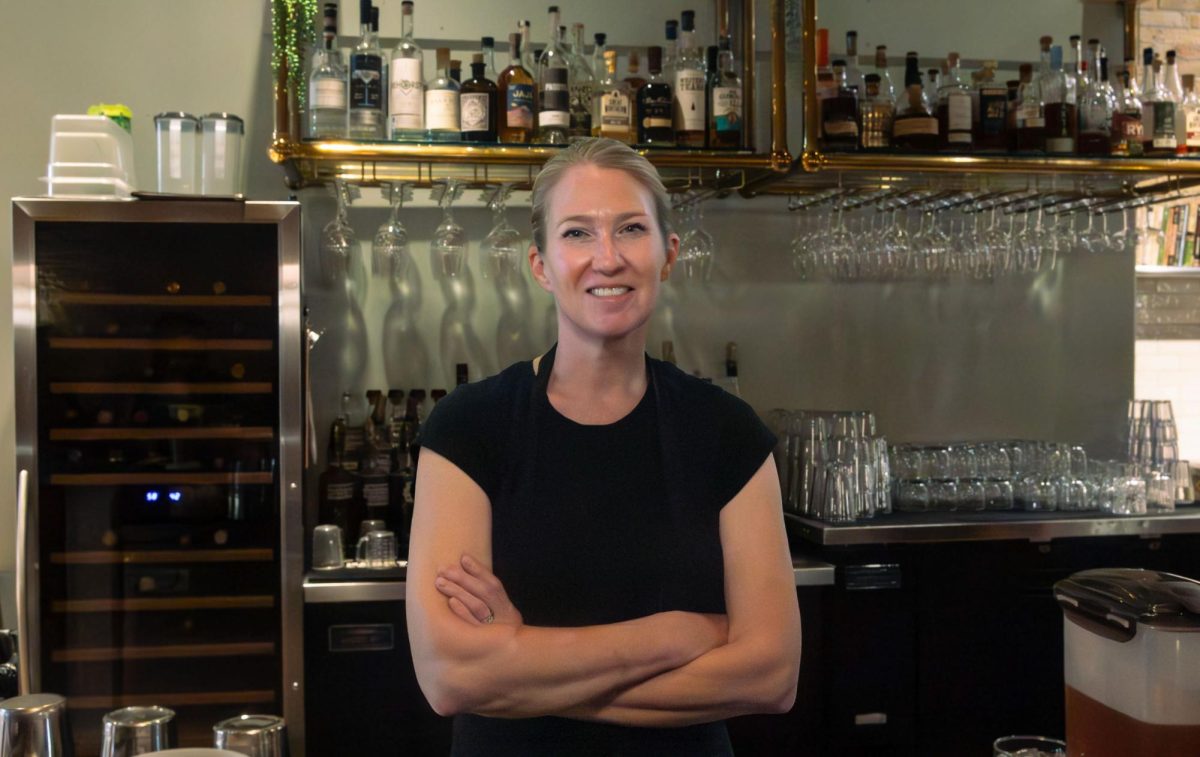
Taking a break from prepping meat for an upcoming dinner service, butcher and restaurant owner Karen Bell shares, “To this day, I still feel like I learn something new every day.”
Cooking spoke to Bell immediately. After her first culinary class at MATC, she knew that cooking would become an integral part of her story. “I fell in love with restaurants before I fell in love with cooking,” she said. Her first restaurant job was as a waitress when she was 15, and her favorite childhood memories still live in the restaurants she dined at with her family. Deciding to take what she calls “the path less traveled” came naturally, and she quickly took to the hands-on approach of culinary school.
After graduating from MATC’s Culinary program, she was hired to help open Vong (later rebranded as Vong’s Thai Kitchen) in downtown Chicago. “They made me come down and do a tasting,” she recalls. “They gave me a bunch of ingredients and said, ‘Make us something. You have two hours. Go.’ That was my interview.” Cooking on the line at Vong became formative for how she would eventually run her own kitchens.
After Chicago, she cooked in San Francisco and eventually adventured to Madrid to explore another part of the world with her sister. She admits, “by the time I got to Spain, I was kind of burnt out with kitchens because I just went all in and was working all the time.” While she planned to take a break from cooking, it did not take long for her to find herself back on the line.
Bell found herself working at a small, American-owned bistro called Toma, and the cultural differences of Spain offered her a sustainable work-life balance. “The way that people eat there is very different… The time that they eat is very different — We opened at 9:30 p.m., but no one would come in until 10 p.m.,” she said.
“It allowed me to have a life outside of the kitchen — I had all day; I could still go out with friends at night because no one goes out until 2 a.m. anyway,” Bell said.
Three years after moving to Spain, she met someone through mutual friends who had recently closed their restaurant. This turnkey space became Memento, a successful “California cuisine” inspired restaurant that she owned and operated for three years.
After six years abroad, Bell found herself missing family so she moved back to Milwaukee with a newfound set of skills. Inspired by Old World influences, she opened Bavette La Boucherie in 2013 — originally envisioning a whole-animal butcher shop. “This was going to be a butcher shop, not a restaurant,” she says. She pictured an intimate “neighborhood spot” where people could come and have a glass of wine or a cheese plate while picking out their meat.
She learned the art of butchering in Chicago and for years, the contents of Bavette La Boucherie’s butcher case were traceable to one animal. The parts of the animals that were not sold (hearts, tongues, brains, etc.) became ingredients of small plate dishes like lamb heart carpaccio and crispy sweet breads that quickly began drawing a crowd. “It just organically started to turn a little bit more into a restaurant,” she recalls.
In 2022, Bavette La Boucherie moved into a larger space about 900 feet away from its original location. “My passion is cooking still to this day, and when I made the move over here, it was a very conscious decision to become more of a restaurant and not as much of a butcher shop,” she said.
Today, she still holds value in what originally drew her to cooking: hospitality and a connection to her community. She explains, “The reason I do it is to see people happy by their experience — not just the food, but the whole experience.”
To newly graduated chefs, she emphasizes perseverance: “it’s not easy, and there’s going to be a lot of times where you want to give up … but if you truly like it, then definitely put the work in and see where it takes you … you can work anywhere in the world.”
Bell encourages viewing mistakes as lessons and “a very positive thing, not a negative thing.” She advises, “The more you try, the more things you do, even if it doesn’t stick — and it might take a few times for it to stick — without actually trying, you’re not going to know. Sometimes it’s hard to do something that’s not expected of you, but I think if it is what your passion is, the benefits will be exponential later in your life.”
As for her own story, she says, “I couldn’t have had it work out more perfectly than it did.”
